

Category:
The Art of Cultivation
– A Conversation with Kia Naddermier –
Kia Naddermier has been practising Ashtanga yoga for more than thirty years. Her teaching weaves together an embodied approach to Mysore practice, classical Pranayama and the Buddha Dharma.
Drawing deeply from both Yogic and Buddhist traditions, it has grown into Yoga Bhāvanā, an integrative approach that strengthens every dimension of practice. Weaving compassion and insight with clear embodied guidance, Yoga Bhāvanā illuminates the full spectrum of our experience – body, breath, heart, mind, and relationship – inviting practitioners into a transformative journey of becoming.
After two weeks guiding a retreat with us at Purple Valley, she sat down to talk about how her practice has evolved, what makes a practice sustainable, the principles that quietly hold her teaching together, and why, in her view, none of us wake up alone.
You’ve been practising for over thirty years, and your approach feels quite unique. How has your relationship with Ashtanga changed over time — and what has shaped the way you practise and teach today?
Kia Naddermier: It’s a really interesting question, because in many ways we change all the time. It’s not necessarily one particular moment that changes a person. I think a healthy practice should change with time to reflect our different stages in life, so that our practice is always attuned to where we are.
But when I began — of course, this was in the mid-90s, and Ashtanga had just reached Europe — I learned it with my teachers in the way that it was taught back then. Quite a strong physical practice. I was quite able, progressing through the sequence as a young girl. But, of course, over time you mature, as a person and as a practitioner as well.
At one point I met my pranayama teacher, when I moved to France — this was early 2000. This is Sri O.P. Tiwari. He spent long periods in France at that time, and he wasn’t very well known, so we were very, very lucky. We had a lot of one-to-one interaction. Refining my understanding of the breath, and how it moves in the body, changed my entire perspective on life, on the body and everything. And, of course, that understanding was then reflected in my alignment — because how you align the body, the body being the container for the breath, and the way you move, with which intention you move, became much more attuned, much deeper.
I’ve been a spiritual seeker since childhood. But the pranayama allowed me to go much deeper into the energetic, the philosophical, the meditative aspects of the path. From there it continues to evolve — it’s probably changed from last year to this year, and to next year as well.
You speak often about sustainability, and it seems central to your approach. What does a sustainable practice mean to you, and how do you bring it into your teaching?
Kia Naddermier: This is very connected to your previous question, actually, because I think a sustainable practice is one that is attuned to where you are on any given day. Both in terms of which stage of your life you’re in, and also attuned to your moment-to-moment experience. Over the period of a day, whether we are practising in the morning or in the evening, the flavour of the practice, and of our body, shifts and changes.
To me, a sustainable practice has to be built on our ability to listen and to observe. Very often that is assumed and not really taught — not really shared, how to listen. I think in our age we really have to learn how to listen. And as a teacher, we need to place a lot of emphasis on that aspect, because then our students can become much more self-guiding. But very often that has to stand back, and instead we learn a lot about practice technique — which is also great — but foundational is this ability to attune our practice to our moment-to-moment experience, and to the stages of our life. And with that, remembering that our practice doesn’t happen in isolation.
There are many causes and conditions that will affect it, and also your own intention with the practice: what is your deeper intention with practising? All of that informs your practice and makes it more or less sustainable. Because what is a sustainable practice for you may not at all be a sustainable practice for me. There’s not really one answer; it’s more of an “it depends.”
In one of your Dharma talks, you spoke about five core principles that support the practice. Could you share what they are, and why they matter so much to you?
Kia Naddermier: I call them the five guiding principles. I guess I’m very inspired by Buddhism, because Buddhism is taught by lists. There are lists upon lists, and even lists of the lists — and this helps memorisation. But really these are just foundational guiding principles that orient my practice. As I practise with them over time, they orient my life as well. It’s not simply pertaining to practice, but really to life.
If we talk about them in terms of the asana practice, the first principle would be Mindfulness — our ability to pay attention. Because what we are unaware of is impossible to work with, but anything that we bring into the light of awareness is workable. Here comes this intention of offering actual tools to learn how to listen, developing a somatic vocabulary. With this in mind, I would begin any type of practice — whether it’s meditation, asana or pranayama — with some form of check-in. It can be a body scan; we could move through the layers, the koshas we talk about in the yogic tradition; or we could simply attune to our belly centre. Some sort of body reading, to know where we begin, and what we’re working with, so that we can calibrate our practice accordingly.
That takes us to the second principle, which is Inquiry. Inquiry is really this ability to open — or at least try — to not knowing. That quality of curiosity, I think of as the life force of my practice. It is what allows my practice to continue to grow, to evolve, to be dynamically alive, to not stagnate. Inquiry helps soften the mind. Because this quality of curiosity, it doesn’t take sides. It investigates all perspectives.
This is a foundational quality, to approach our practice — both with mindful, non-judgmental attention, and with a quality of curiosity. Which folds into the next principle, which is Care, or metta in Pali, maitri in Sanskrit. This is the climate in which we hold our entire practice. These principles aren’t steps; they fold into each other. But looking at that quality in terms of our asana practice, it’s cultivating a sense of warmth in the body. Taking time to warm up the tissues and joint spaces, before we throw the body into a strong practice routine such as Ashtanga Yoga. I don’t know any other physical modality that doesn’t include some kind of warm-up — and I don’t consider a conventional Surya Namaskar a warm-up, because it already asks for deep forward folds and spinal extensions. It’s a beautiful practice, but maybe not the very first movement we want for the body — especially first thing in the morning.
That takes us to the next principle, which is Centering. Both Western and Eastern wisdom traditions acknowledge the centre of gravity in the body, the deep navel centre, the Hara, to be the keystone which organises the entire body. From this centre core, we can then direct energy towards the periphery, but it also acts as a reliable point of return. Now, the exploration of Hara has many layers. It’s more than a physical place in the body — it’s also a listening centre. One way of attuning to our sense of being, to come to know all its layers, is actually directing ourselves back to this home ground of body intelligence.
These first four principles then lead to the fifth principle, which is Freedom. This is an integrated freedom that encompasses Mindfulness, Curiosity, Care, and Centering — all of these open for a sense of freedom. If we’re talking about the principles in conjunction with asana, this is an integrated ability to move freely — not just passive flexibility, but functional and free movement. The quality of ease of movement guides the way, rather than the range of motion. Remembering that a larger range of motion isn’t necessarily better; that can, speaking from my own experience, be destabilising for the joints.
I just want to pause here for a moment, by saying that all of the things I’m sharing with you are things that I need to learn. I’m still working very much on this. But this is the foundation of how I share anything.
You also speak about “loud” and “quiet” postures. Could you say more about that?
Kia Naddermier: Absolutely. Extreme yoga postures are incredibly loud information for the physical body. Nothing wrong with them in and of themselves, but if we want to cultivate deep listening — if we want to really learn interoception, proprioception, kinaesthesia — we need to do that in simplicity and not at an end-range position, so that we can actually hear the more subtle messages from the body, and not just these louder roars that happen in extreme postures.
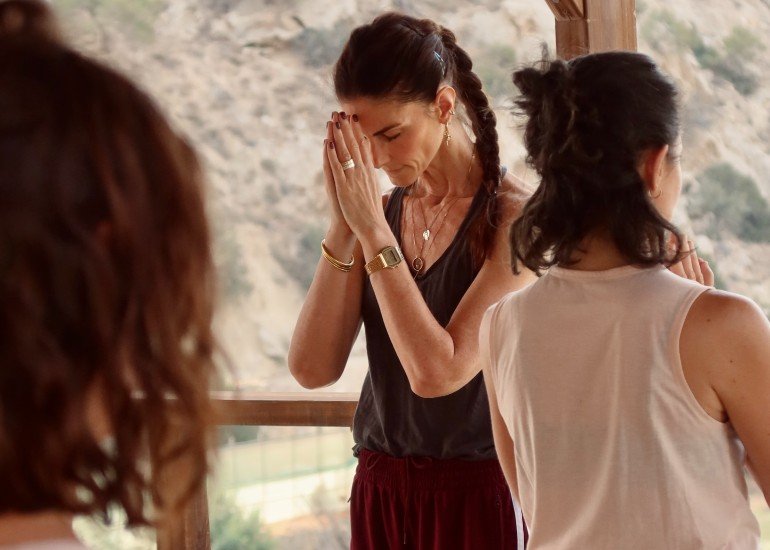
You created *Kāya Bhāvanā* – somatic preparatory sequences – and from the inside it feels deeply intuitive. How did it develop, and what was your intention behind it?
Kia Naddermier: Kāya Bhāvanā (The Cultivation of Embodiment) is part of a larger umbrella I call Yoga Bhāvanā. Bhāvanā means cultivation, development, bringing into being — I like to translate it as familiarisation. It is said to be the word that the Buddha used the most. And the word yoga is, of course, quite difficult to translate, but I translate it as integration. So, Yoga Bhāvanā — the Cultivation of Integration. I am engaged in, we could say, four aspects of that on a daily basis, that constitute my practice. Part of that is Āsana Bhāvanā, the cultivation of āsana. But within that larger umbrella of āsana, Kāya Bhāvanā forms an integral foundation.
These are somatic preparatory sequences that are designed to bring us back to our body’s innate intelligence, so that asanas can unfold with intentionality, clarity, stability and ease. We often begin Kāya Bhāvanā with a body scan, and there are different ways that I guide practitioners to learn, to read the different layers of their body. Then we bring in that sense of inquiry as we begin to warm up the tissues and joint spaces.
What is really interesting to think about is that our somatic universe is only as large as our perception of it. When we are cultivating this refined body awareness, we are expanding our somatic universe. What happens then is that this quality is brought into your asana practice, and into your life eventually. We begin to practise, and ultimately live, in a more continually open state. When we are more aware, then we are better able to attune to the rhythms happening both within and around us. And then something remarkable happens: we become connected to Source. The Source of body intelligence in the physical body resides at the belly centre, the Hara. Kāya Bhāvanā recognises the Hara as the seat of the self, centred in the present. And that builds the foundation for how we then move into our āsana practice.
You also speak of “warriorship” in your teaching. What does being a warrior mean to you, in the context of practice?
Kia Naddermier: Stepping into a situation with that quality of not knowing everything. Stepping into a situation, or into our practice, with that sense of curiosity. Because curiosity, or inquiry, is literally to open to not knowing — and that requires fierce courage. And also, when we come more to the Buddha Dharma and the meditation practice: when we want to cultivate true compassion, we first need to be willing to feel our own feelings. The more we ward off our own feelings, the less we are able to actually understand and empathise with others. That level of intimacy with our own experience, with our own feelings — our day-to-day weather system, if you like — requires, again, that kind of courage. This is what is called, in the Buddhist tradition, spiritual warriorship. Because very often our trouble, or challenge, with meditation practice is not really about trying to be calm or quieting the mind. It’s to face ourselves. It’s tolerating the intensity of intimacy that sitting still, and being with ourselves, requires. That, again, is a training.
In Yoga Bhāvanā, I said asana is one aspect. Prāna Bhāvanā is another aspect, cultivating prana, the energy body. But then we have Citta Bhāvanā, which is mind training. And Mettā Bhāvanā, which again is the climate that we hold our entire practice life within.
You practise Buddhism, and I’ve often heard you speak of the interconnectedness of everything. How does that understanding shape the way you see the body, the practice, and our relationship with the world?
Kia Naddermier: That’s such an important and beautiful question. In Buddhism, interdependence is a huge topic. I think, personally, one of the biggest challenges in Western spirituality and yoga is this idea of being a separate self on its path to healing. What we have to wake up to is that there is no separate self here, but a belonging that is connected to absolutely everything and everyone else — and that we are all waking up together. I cannot be on this path to healing, and move into a state of awakening, if you are suffering. So we’re waking up together. Zen master Thich Nhat Hanh has coined a beautiful word: interbeing.
That also shows the responsibility we have, to actually care for one another. Compassion is central to Mahayana Buddhism. Yes, we are each on a path to wake up, but in this tradition, the reason why we are doing this work is so that we can serve other beings in the most skilful way possible. Because as we all know, very often we want to help but are not very skilful in how we do so. That doesn’t mean that we can’t start exactly where we are and serve other beings. But there’s also this idea of the path to our personal growth not stopping at our own liberation. This is something I often find missing in the Western conversation about yoga, and spirituality. It is very much about me, my practice and my progression. But here we really take some time to reflect on why. What is your motivation? In the Mahayana Buddhist view, it is so that we can be of service, in the best possible way for as many beings as possible.
Join Kia Naddermier at Purple Valley. Kia returns to Purple Valley to teach Yoga Bhāvanā – The Art of Cultivation, a retreat weaving Ashtanga, Pranayama, Meditation and the Buddha Dharma
Goa Retreat
- YOGA BHĀVANĀ – THE ART OF CULTIVATION: Aṣṭāṅga Yoga | Prāṇāyāma | Meditation | Buddha Dharma
December 5, 2026 – December 19, 2026
Tenerife Retreat
- YOGA BHĀVANĀ – The Art of Cultivation
February 13, 2027 – February 20, 2027