
Category:
Between Tradition and Adaptation:
A Conversation with Adam Keen
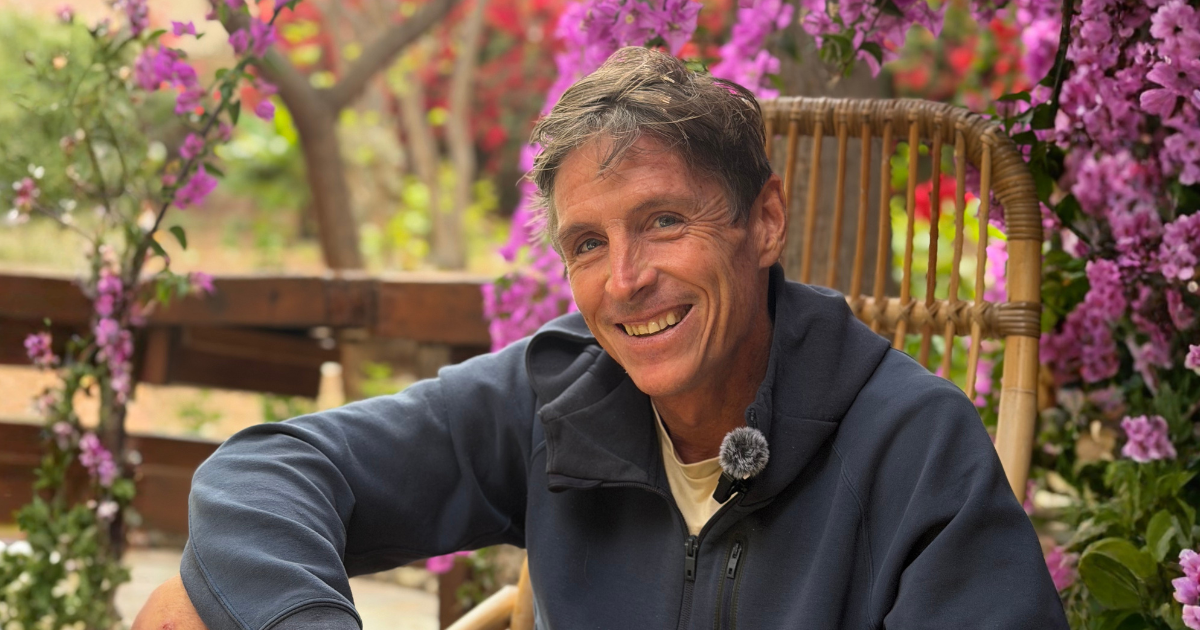
Adam Keen has spent more than twenty years teaching Ashtanga yoga, and for many of them he has returned to Purple Valley in Goa as one of our teachers. Alongside his teaching, he hosts the Keen on Yoga podcast, where he speaks with teachers and scholars about the practice, its history, and where it is heading. This December he joins us again for two weeks over Christmas and the New Year — as always, a warm and welcoming group of all ages and levels.
This conversation was first shared on our YouTube channel, and we’re offering it here in written form as well, so that it can reach those who haven’t yet had the chance to hear him. In it, Adam sat down to talk about the globalisation of yoga and its rapidly changing landscape — the tradition and the culture it comes from, the question of appropriation, the place of yoga philosophy, and how he holds the Ashtanga method today.
After more than twenty years teaching, do you feel a responsibility toward the tradition of yoga and the culture of India — and what version of yoga do you hope to ignite in your students?
Adam: If I think back, it was contextualised to me when I first learned it in purely gymnastic form — and that’s kind of what interested me. As a philosophy student I was very interested in Indian philosophy, but the gymnastic form of yoga was over here, separate; and my teacher at the time even cut out the Ashtanga mantra. He was really not interested in any kind of cultural baggage around this — he just wanted to do the asana. And he attracted me, and it kept me going.
I feel we have to believe that the student has the ability, and the interest and commitment over time, to take the mantra to themselves, so to say. For most people, if you take yoga in its fullest iteration and shove it down the throat of someone who just wants to be calmer, to get toned and healthy and feel better, I think it would scare a lot of people away. So it’s tricky, because in one capacity I’m going to say yes, it’s important to contextualise it — the very way that you move your body depends on the context in which it’s defined for you. Nevertheless, I’d also say that however people get into yoga asana, I’m kind of okay with that. I don’t mind how they’re hooked, if they continue.
I’m of the firm belief that people aren’t dumb; over time, if they keep practising, they’ll have the capacity and the interest to find out what’s going on — where it came from: Pattabhi Jois in Ashtanga, and where Jois got it from, Krishnamacharya, and where Krishnamacharya got it from. And then it blows up after that. Because when we talk about yoga, we’re obviously talking about a very ambiguous term, which has been used in many ways over thousands of years in India. Originally it was an ascetic practice — simply holding a hand in the air, sitting around fires, scorching in the midday sun; nothing really about union, but about disunion. So the context of what we’re talking about has shifted massively as well.
No one likes things being shoved down their throat, whether it’s Christianity or the ideas that surround yoga. So it’s about tailoring it to the individual, and whatever makes it accessible to them initially. Look at hatha — the root, “forceful”: something you do bloody-mindedly, as we say in English; stubbornly. Anything that you get up and do every day when you don’t want to — and I’ve never wanted to get up and do yoga first thing in the morning; I wanted a coffee and a croissant, and I used to want a cigarette too. But you do something consistently, against your natural desires for comfort and ease, and that methodology has always been at the root of yoga: something done consistently. Over a period of time, the mind will naturally settle down into asking further questions about it.
Many Indians feel uncomfortable seeing yoga represented online as “yoga for abs” or “yoga for a nice booty.” Does that bother you?
Adam: It bothers me, yes. And more recently, as I travel the world more and see other appropriations of my own culture, I understand the feeling a bit more. On the other hand, I wouldn’t legislate that people can’t interpret things as they want; it seems a bit harsh, and a bit negative. For example, I was just in a café here in Goa, hearing Indian people play fantastic covers of songs I grew up listening to — songs that have a culture around them, particular to Britain and what we went through. Can other people enjoy them and talk about them? Of course; I wouldn’t want to deny that. It’s the same in Thailand at Christmas — the Thais are getting super interested in Christmas, in Santa and eating the traditional stuff. It seems a bit unfair to say they can’t enjoy anything about Christmas.
There’s also, in the yoga context, a methodology which is independent of culture, which you can extract from it — albeit that the methodology has changed. At one point it was penance, basically tapas, restraint; at another point, around the medieval period, it reversed and became a tantric thing of chakras and kundalini and nadis. And more recently we have Krishnamacharya, one of the first people using yoga for therapy.
Seeing “yoga for abs” is so far off beam that it becomes absolutely ridiculous — you almost just swipe past it. But the thing with yoga in the modern sense is that you’ve got a breath-related movement, and I think that’s what will win through. It affected me in a different way from my martial-arts background, or anything else I was doing. We all still have mixed motives towards yoga — if we didn’t, we wouldn’t need it; we wouldn’t need to get on a mat. So if the motive is to get nice abs, and also to breathe — something about the breathing — then ultimately, over time, that deeper motive is going to come to the surface.
When a student comes for the primary series but is hungry for something more, and wants to approach it authentically, how do you introduce them to that deeper dimension?
Adam: We have to remember that when yoga came to the West, it came under the auspices of asana first. Asana was prioritised by B.K.S. Iyengar, by Krishnamacharya in his early days, and by Jois — and they were all interested in something more; they were using asana because it attracted people. Jois used to say, “How can you know God if you don’t know your big toe?” There’s something about purifying, about cleansing the doors of perception, as Huxley would say, before you can think clearly. Give someone a yoga text and, until something has happened to the body’s energy, they’re just going to read it with their complete conditioning. There’s this understanding in yoga that the body and the mind cannot be separated — which is another particularity that defines yoga from non-yoga.
To answer your question: the way that you stretch can start to confer the meaning. Yoga, let’s call it, is still a restraint — restraining the senses, which are the bridge to the desire; you restrain the desire, and the motive — even, looking at the Gita, the looking for the fruits of the action — and then you’re thrust back on yourself. What are you left with, if you don’t have a motive anymore? That can be symbolised in the way people stretch. If we’re pushing people into bigger and bigger shapes without an idea of balance — the asana is contextualised by opposing tension forces that point back into the body — then of course they’ll just think yoga is the normal stuff: desire for betterment, personal accomplishment, something in the future that’s going to be better for me. But if that’s understood on the physical level, it trickles straight down to the deeper intent.
Unfortunately the Ashtanga method is this kind of linear, chase-the-carrot thing; it keeps the motor running, but it also encourages the ego. Nevertheless, if you stick with it long enough, sooner or later that whole parade is going to crumble — you’re going to get injured, you’re going to get disappointed, you’re going to get to an advanced sequence and just think, “what now?” — and you’ll be thrown back on yourself. I kind of believe that human nature is essentially intelligent and has the deepest question at heart; you’ve just got to cut through everything to get to it — “what is this, and what the hell am I doing here?” So it’s construed in the way you actually teach the literal asana. You don’t even need to touch yoga philosophy; you just have to trust that the practice and the technique themselves will give birth to that deeper curiosity.
And one has to realise one’s own limitations. I’m just a yoga teacher who’s enjoyed the method for a bunch of years. As an asana teacher there’s already a sense of imposter syndrome — who am I, in the end, to legislate on someone else’s peace of mind, or even their body? So I think it’s important to say: I don’t know any more than you do, really — but I have a whole bunch of tools that you might not know about, and I can point you in directions. I’ve interviewed, on my podcast, a whole bunch of much more intelligent people than me — Indians, academic and non-academic — who know a lot more, and I can send students to that podcast, or to a book I really loved. As a yoga teacher, you’re not expected to know everything, and I think that’s really important to say.
For some, that discomfort of “not doing enough” gets soothed by appealing to lineage and method, which can tip into something almost authoritarian — as if there were only one way to access yoga. How do you respond to that temptation while staying true to what you’ve learned?
Adam: I think we’re at a really interesting point in history. Since Vivekananda — who famously said, go into your room and get the truth out of yourself — there’s this idea, similar to the Reformation around Christianity, that you don’t have to have a mediated experience of God, or of yourself, anymore. You can take the bull by the horns and have this experience, which in the end is always going to be a subjective experience. It’s the same in the Bhagavad Gita: in the end, the Vedas are for someone who doesn’t yet know the truth, but for one who knows, the Vedas are irrelevant, because the truth is embodied. We’re up to the hilt with information already. So we’re in an interesting time, where we’ve been allowed more autonomy than maybe we ever had, and I think that’s really important.
But then it swings to the other side. The problem with the whole new-age thing, and the syncretism around it — picking a little bit from here and there — is that you end up with no method anymore. Tradition is something I’ll never tire of discussing, because it’s such a nuanced topic and there’s no conclusive answer. It’s always been wielded as a vessel of control — but it also contains a methodology, a way of doing things, that has worked for many, many people. So to try and reinvent a method now, rather than use all the people who have gone before, is super hubristic, as well as really stupid. On the other hand, we have to have a sense of autonomy in the face of the method as well; otherwise we’re just conforming to someone else’s ideas about how we should turn up, how we should be, how we should move. There’s no easy answer out of that.
You describe your own approach as “modern traditional.” What has to be preserved in the method, and where is there room to adapt it?
Adam: I think we have to look at the deeper aspects — not the specifics, or the politics, or belonging to a club — and ask, what was the essence of Krishnamacharya’s teaching? Because he and a couple of others are at the centre of what we’re currently doing. It was based on vinyasa — the idea of entering and exiting a posture with awareness — on counter-posture, and it was dynamic: a modern way to move, whereas previously, both in India and in the West, static forms of movement were more the norm. And then you’ve got the methodology of what Jois called the tristhana — bandha, breath, and drishti — which are also found at the heart of the classical tantric texts, although without the dynamism. As long as you’ve got that at the heart of it, that’s the method; the specifics are where you can be more flexible.
The sequences aren’t a magic combination lock to enlightenment. You can use placeholders, you can adapt the posture to suit you, and you can find the essence of the posture — which is not the outer form, but the essence of opposing forces within it. So there’s something to be preserved, but it doesn’t need to be as literal as, if you can’t bind in Marichyasana D, you can’t do any more. I’d still call myself, in inverted commas, a “modern traditional” Ashtanga teacher — the Ashtanga tradition is still very recent, not thousands of years old — but the basis of this asana practice, formatted on bandha, breath and drishti and the idea of vinyasa, is a teaching tool I really enjoy.
I’ll also add that I don’t necessarily want to disband the mythology around the whole thing, either. I got into it partly because of the story — Jois, and his guru Ramamohan Brahmachari — and it’s kind of sad that Father Christmas has been killed, in a way, because we all trade on working myths. To have everything rational may be truer in a literal sense, but it doesn’t really motivate you; we’re not rational at heart, we’re emotional at heart. When I first read Mark Singleton’s Yoga Body — where he traces where Krishnamacharya may have got the sequences from, partly even from Western calisthenics — I was mad, because I wanted it to be this special, esoteric, Indian thing. But having it there in your face makes your quest a bit sharper: what is this, then, if it’s not all that mystical stuff? The danger is that we squash that extra dimension out of it by just treating it like a modern Western calisthenics, which it isn’t.
And how has your own journey — from Mysore, working within that style, to a more individual approach — shaped the way you hold the practice now?
Adam: I think a lot of the rigidity is created by Western students coming back and holding the method — “I know the method and you don’t” — as a way of justifying their position as teachers. If you actually go to Mysore, it’s always been more individually adapted: older people, or people lacking a certain ability, were always given latitude to carry on. It was never as litigious as Western teachers coming back and saying, “this is how you do it.” On the other hand, yes, the method in Mysore was increasingly tightened up. Jois didn’t start teaching in such a rigid manner — David Williams was able to modify it, and Jois taught Nancy Gilgoff completely differently from David Williams.
Where it was tightened, I felt it was largely due to logistics. Jois changed his teaching the more people came through; you have a whole bunch of people, many of whom hardly know much about Ashtanga, and what are you going to do — sit down with each one and ask about their practice, their health history? You have to have easy answers. That’s why the originally very long advanced series was split into four different series — people were having four-hour practices, and as more came in, you couldn’t have that. In the most positive light, more people got the experience of it.
I’ll admit something: even though I was practising Ashtanga before I went to Mysore, I never understood it until I went and heard Sharath counting the method, teaching specifically in the Mysore room. I never understood it the same way outside that teacher; even seeing them on tour, it wasn’t the same as going there. There was something I experienced there, in a deep way, that I can’t really articulate. So I don’t see any discrepancy — I feel I’m a traditional Ashtanga teacher, and I still teach the method, because there’s something helpful about sticking to something, devoting yourself to something higher than yourself, rather than “I fancy this vinyasa today, I fancy that today,” which is a bit of a slippery slope. Before I went to Mysore, I started adding in all the handstands and the stuff I wanted to do, and fudging the stuff I couldn’t really do. When you go to Mysore, you have to give yourself over to a method and a perspective that isn’t always of your liking, and something comes up for you because of that.
But the danger is that the teacher then takes that and says, “I’m going to push your buttons by denying you postures.” That’s when you have to have the compassion and the understanding of why you’re really teaching, and see what the individual body can and can’t do. Sometimes I’ll keep a person out of a posture because I know that, with a little more concentration, they’ll do it. But if their genetics, their current abilities and their frustration are building, month after month, a lot of it is fairly pragmatic: you don’t want someone to injure themselves trying to force something out of frustration, or to quit because they’re bored and frustrated because you stopped them. Used with sensible tools, by a sensible adult, I think there’s no discrepancy between continuing a method that has worked for many and altering it so it’s compassionate, holistic and helpful to the individual.
Where do you stand on the idea that yoga has become a kind of therapy — something to feel good, or to ease anxiety — when the texts suggest it once meant something quite different?
Adam: There’s a quote by Georg Feuerstein, in Yoga Unveiled years ago. Feeling better, reducing anxiety, yoga for mental health, yoga for trauma awareness — they’re all relevant, valid, reasonable ways to use and apply yoga. But, as Feuerstein says, it’s a little bit to shortchange oneself to end there.
One big difference between yoga as a therapy now and yoga in Krishnamacharya’s idea of therapy is that the Eastern perspective treats the body holistically, as a whole that functions together — body, mind and spirit, and the emotions — whereas the Western perspective still has this dualistic approach; as much as we try to get rid of it, we can’t, it’s in the hard wiring now between body and mind. So when people approach yoga as a therapy now, it’s, “I need to add the pigeon to open the hip,” or “I need some different stretches to get into this backbend.” It’s understandable, and in a way I go down that path too — for some people, some preparations are useful and necessary. But when Krishnamacharya was talking about yoga therapy, he was looking at a methodology of treating the whole body together, and approaching the tension much more deeply than the Western deconstructionist way, which says: my hip is tight, therefore the cause is my hip, therefore the conclusion is to work on my hip. What Krishnamacharya is saying is much deeper — your hip is tight because of the matrix of general tension in your whole body.
Now, one has to be clear that it’s not, “oh, you’re stiff, therefore your mind’s stiff” — I really don’t like that either. We’ve all got tension in the body; it goes much deeper, and how it manifests will be different for each person. But treating the hip as just the cause and the effect doesn’t make sense. There’s structural tightness in the body not just because a muscle is tight, but because we hold ourselves in certain emotional patterns of tension. When we keep to that flow — getting into the flow state, the groove, the rhythm — it unlocks the spirit and the emotions in a deeper way than you ever could with the mind, because with the mind you’re kind of setting up a battle: I feel my hip is tight, the mind needs to rectify it, and the body has a tightness that wants to be heard. The whole thing gradually unfolds from the inside out, rather than looking at it top-down, the mind controlling the body. So the ultimate yoga as therapy treats the root cause, in a deeper way than plucking the head off a weed while the root is still there.
Adam’s upcoming retreat in Goa — December 19, 2026 – January 2, 2027:
This December, Adam returns to Goa for two weeks over Christmas and the New Year — Mysore self-practice and led classes, workshops on asana technique, and afternoons of breathwork, relaxation and yoga philosophy. Prices start from £1,350 for a shared room and £1,600 for a single, including accommodation, food and daily yoga classes. Ashtanga Yoga & Self Enquiry – Practical Tools to Change Your Life
Adam’s upcoming retreats in Tenerife – Spring
For teachers and long-term students — a week to look beyond the sequence, with workshops, discussion and daily Mysore practice, toward more clarity in both your own practice and your teaching: Intensive Retreat for Ashtanga Yoga Teachers · 27 March – 3 April 2027
A practical look at making a traditional practice your own — questioning rigid ideas and building a more sustainable, intelligent relationship with the practice: Authentic Ashtanga — Make the Tradition Work for You · 3 – 10 April 2027